Screenwashed: A Book Proposal
Every generation has a hole in its heart. This book explains who put it there.

A Nonfiction Book Proposal By
JOSHUA H TYLER
The entertainment you watch has never been less interested in giving you what you want. It has other plans.
The most effective way to influence someone isn’t by giving them orders. It’s by making them feel like each step forward is their idea, until they arrive exactly where you wanted them to be. They think they’re choosing freely, while someone else is quietly arranging the choices.
Advertisers understand this. James Bond never stops the movie, stares into the camera, and orders everyone to buy an Aston Martin. He simply makes driving one look desirable. The audience supplies the next thought: I want that. Advertisers spend enormous amounts of money placing products in movies because they know a sales pitch is more powerful when it feels like your own idea.
Screenwashed asks what happens when those same techniques are applied to beliefs about family, success, education, authority, and morality.
Most film and television commentary judges entertainment by how well it tells a story. But a beautifully told story can still lead you somewhere you never agreed to go. It’s like filling Pepsi cans with lemonade and then excusing the deception by telling consumers it’s really good lemonade. It’s the dishonesty that’s the problem, not the quality of the liquid in the can.
Screenwashed uses movies and popular culture to give readers the tools they need to spot the persuasion techniques being used against them. Through familiar stories, an original vocabulary, and full-color comic-book-style illustrations, it teaches readers to recognize where entertainment is leading them before accepting its conclusions as their own.
Each chapter introduces an influence pattern, explains how it works, and demonstrates it through movies, television, and real-world examples. Mary Poppins becomes a lesson in Emotional Reframing, showing how a trusted family movie makes responsibility feel irresponsible. Pleasantville provides a visually literal demonstration of Affective Conditioning, attaching moral judgments to color and black-and-white imagery. The Day the Earth Stood Still introduces Virtue Tolls and connects the pressure to demonstrate goodness with the charitable demands readers encounter at a checkout.
Screenwashed also supplies a solution to dishonest manipulation: Reasoncraft, persuasion through openly stated reasons and honest exploration rather than manipulation. Using Star Trek as a classroom, Screenwashed shows how fiction can present competing arguments and invite audiences to reason through them.
Bestselling books like Influence have explained the principles of persuasion. Cultish examined the language that shapes beliefs. Screenwashed is the first book to bring entertainment analysis, persuasion terminology, and an explicit argument about the ethics of hidden influence together in one easy-to-understand framework.
Joshua H Tyler’s approach draws on more than twenty-five years spent analyzing entertainment and building audiences as the founder of CinemaBlend and Giant Freakin Robot, alongside formal training as a certified consulting hypnotist.
Screenwashed is written for readers who want to better understand how entertainment influences beliefs, behavior, and culture. While the book uses movies and television as its primary teaching tools, its subject is persuasion itself. As a result, its audience extends well beyond film enthusiasts into readers interested in psychology, communication, media literacy, parenting, education, advertising, and self-improvement.
Strong evidence for this audience already exists. Before developing this book, I spent several months testing its ideas through the Screenwashed YouTube channel. The channel functioned as a real-world laboratory, allowing me to measure not only which concepts attracted viewers, but which ideas generated the strongest engagement, discussion, repeat viewing, and requests for additional content.
The Screenwashed audience demonstrates an unusually high level of engagement and loyalty. Across the channel, viewers are not passive consumers but active participants who regularly discuss, debate, and share the ideas presented. This suggests an audience invested in the underlying concepts rather than simply individual videos.
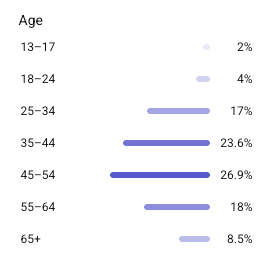
Screenwashed’s audience is heavily concentrated among mature adult viewers who seek long-form analysis: 68.5% are ages 35–64, including 26.9% ages 45–54 and 23.6% ages 35–44.
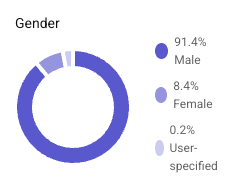
Current YouTube analytics show that 91% of Screenwashed viewers are male. While the channel has found particularly strong resonance with men, the book’s broader focus on parenting, media literacy, education, and critical thinking provides opportunities to expand beyond the existing audience.
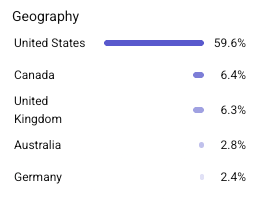
Viewers for the YouTube channel are concentrated in English-speaking markets, with 60% in the United States alone.
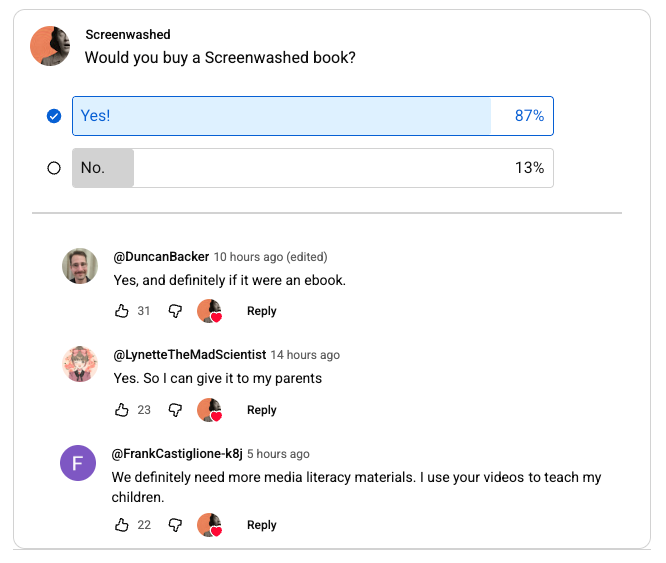
Audience metrics demonstrate interest. Viewer comments demonstrate demand. The following real responses taken from our YouTube channel are representative of the enthusiasm Screenwashed has consistently generated.









The audience already demonstrated by Screenwashed is only the beginning. While the channel attracts movie fans, the book’s real subject is influence. Because its framework applies equally to entertainment, advertising, education, politics, and everyday communication, Screenwashed has the potential to reach a much broader audience than the YouTube channel alone.
Screenwashed has a clear path to success, thanks to the trail blazed by the following books. They prove there’s a market for accessible nonfiction that helps readers better understand themselves and the world around them. Each explores part of the territory Screenwashed covers. None combines entertainment, persuasion, original terminology, and visual teaching tools into the practical framework Screenwashed provides.
Influence: The Psychology of Persuasion
Robert Cialdini (1984)
Robert Cialdini has been called the Godzilla of persuasion, and Influence is widely regarded as one of the foundational books on the subject. Having sold more than five million copies worldwide, it established an enduring market for accessible books about how persuasion works. Where Cialdini explains influence through research and real-world examples, Screenwashed uses entertainment as its classroom. By teaching persuasion through stories readers already know, it transforms abstract psychological principles into practical tools that are immediately recognizable.
Win Bigly: Persuasion in a World Where Facts Don’t Matter
Scott Adams (2017)
Scott Adams has numerous top-selling books on humor, persuasion, self-help, and culture. His 2017 book Win Bigly debuted at number 14 on the national hardcover bestseller list and continues to sell bigly. He proved there’s a significant audience for nonfiction that teaches persuasion techniques through a cultural lens. Screenwashed brings that approach to entertainment, using familiar movies and television shows to teach readers how influence works.
Think Again: The Power of Knowing What You Don’t Know
Adam Grant (2021)
In 2021, Adam Grant’s self-help hit Think Again hit number 1 on the New York Times bestseller list by giving people a framework to rethink their beliefs and examine how they came to them. Since then, Grant has sold millions of copies and been translated into 45 languages. He connected with readers by combining research and observation with stories from business, sports, education, and public life. Screenwashed takes a similar approach to teaching readers how to rethink their assumptions by helping them notice the outside influences that shaped them in entertainment.
Cultish
Amanda Montell (2021)
In her New York Times bestseller Cultish, Amanda Montell reveals the hidden influence affecting us all and teaches her readers to recognize linguistic patterns that shape our beliefs and attitudes. Screenwashed takes this approach directly to the more accessible world of entertainment, gives readers a vocabulary for identifying its influence, and empowers people to see patterns they’ve never noticed before.
You Are What You Watch
Walt Hickey (2023)
Pulitzer Prize-winning author Walt Hickey takes a data-driven approach to demonstrate that people are influenced by their screens in You Are What You Watch. Critics praised Hickey’s book, and Screenwashed takes the next step by identifying the mechanisms entertainment uses to persuade viewers and shape their thinking, doing so with an accessible approach.
Joshua H Tyler is a certified consulting hypnotist, writer, film critic, entrepreneur, and internet pioneer; one of the earliest independent publishers to find sustained success online. His first published work appeared on the internet in 1997 and has long since vanished into the ancient mists of the early web.
In 2000, Josh founded an independent entertainment news website. Though it began under a different and far sillier name, that site would eventually become CinemaBlend.
CinemaBlend grew to employ more than thirty writers and editors, covering breaking news, film festivals, movies, and television around the world. In 2007, Time Magazine recognized Josh among the internet’s influential and critically clever film journalists. By the time Josh sold and exited the company in 2015, CinemaBlend had become the web’s most-read entertainment publication and ranked among the 4,000 most-visited websites worldwide.
After the sale, Josh took a break from running media companies to study hypnotism. He spent a year training under an elderly martial artist who once fought Bruce Lee, hypnotized dozens of subjects on his way to certification, and became a consulting hypnotist.
Josh later returned to run Giant Freakin Robot, a news and opinion site he founded in 2008. Despite its silly name, Giant Freakin Robot also rose to rank among the 4,000 most-visited websites worldwide.
In addition to running Giant Freakin Robot, Josh writes, produces, edits, and narrates videos for the Giant Freakin Robot and Screenwashed YouTube channels. He also serves as board chair of Red Barn Chess, an awarded community nonprofit where he volunteers his time and resources to help children develop critical-thinking skills.
Josh’s unique experiences involving decades spent studying entertainment, building online audiences, and examining persuasion led directly to the creation of Screenwashed.
Joshua H Tyler has spent more than twenty-five years building audiences around entertainment and promoting content to them. His successes include:
Joshua will be able to support promotion of Screenwashed through the following channels.
Screenwashed is organized as a progressive framework. Each chapter introduces a new influence pattern, explains how it works, and demonstrates it through familiar movies, television shows, and real-world examples.
Preface
Entertainment as empty calories is a facade. In this chapter, Screenwashed lays the groundwork to teach the reader about the way the content they consume influences their beliefs, opinions, and patterns of thought. It begins with a personal story about a martial arts hypnotist and uses that to teach readers that anyone can be influenced. Even them. It promises Screenwashed will give anyone who reads it the ability to see the hidden world of persuasion operating beneath the entertainment they consume and the culture surrounding it.
Chapter 1: You Can’t Fight The Future, But You Can Get People To Stop Planning For It
The worst thing that ever happened to families was the most popular family movie of all time. Screenwashed explains how Mary Poppins uses Emotional Reframing to teach children that adults who plan are villains, that mothers don’t need to be present, and that money is something you feel about, not something you manage. It wraps that lesson in warmth, then dares you to question it without looking like the bad guy yourself.
Chapter 2: Normalizing Naked Sensationalism
Joshua explains how having cheeseburgers thrown at his Tesla proves he’s a curmudgeon and also that Americans were influenced by a movie called Network. Screenwashed demonstrates how both Network and the George Clooney movie Good Night, And Good Luck used a persuasion technique called Affective Conditioning to lead audiences into two very different conclusions about the way we get facts.
Chapter 3: The Belonging Drug
People don’t just want to belong; they need to. Rejection isn’t treated by the brain as a metaphorical pain; it registers the same way as physical harm. That means people will do almost anything to make sure they belong. Joshua relates how this human need impacted him personally, then uses visual explanations to show how One Battle After Another hijacks our need for acceptance, persuading people to trap themselves inside a mental prison.
Chapter 4: Paying The Virtue Toll
Hands up, don’t shoot Klaatu! Screenwashed beams into the world of classic sci-fi to uncover the surprising effect The Day the Earth Stood Still had on your Taco Bell drive-thru experience. Those incessant requests for charitable giving at the checkout are something called Virtue Tolls, and this chapter explains how one of cinema’s most influential science-fiction films helped normalize them, while revealing a better way to do good in the world.
Chapter 5: The Failure Cult
Humans don’t make decisions based on logic. Our feelings point the way. Screenwashed explores how The Graduate used those feelings to convince its audience that success is failure and failure is success. Freedom becomes a prison when boredom is the ultimate evil.
Chapter 6: The Debt Party
With Joshua’s daughter struggling to find a career, he takes readers into the world of higher education that started when the Vietnam War ended. Screenwashed cannonballs into the world of college raunch comedies to expose how men were tricked into living a life of debt slavery, just to get a shot at banging some girl from a sorority.
Chapter 7: The Sin Of Usefulness
That previous chapter may have you questioning the value of college. Fear not, A Man On The Inside is here to persuade you into believing that education is supposed to be dumb! Screenwashed reveals how A Man on the Inside reframes skepticism about higher education as a moral failing, teaching audiences that questioning college means rejecting family, community, and compassion itself. And in the end it proves that the only sin worse than uselessness is usefulness itself.
Chapter 8: The Wife Smear
In between the election of Richard Nixon and the massive increase in women abandoning their lives as housewives was a failed science fiction movie. A science fiction movie that did what all the bra-burning flower power of the 1960s could not, even though no one watched it. Screenwashed discovers how The Stepford Wives turned families on their heads and persuaded women to go to work.
Chapter 9: All Killers Go To Heaven
Screenwashed enters the world of the Manson Family and discovers that modern day Christians would have forgiven them. Culture changed because a movie called Star Wars figured out how to modify beliefs using a persuasion technique Joshua calls Heartwashing.
Chapter 10: Pavlov’s Movie
Not every movie that attempts to covertly persuade its audience succeeds right away. Sometimes, the agenda being pushed is so outlandish and ridiculous that it needs more time to take hold. Screenwashed looks into Pleasantville’s attack on Americans’ rosy view of the past with a clumsy, Pavlovian sledgehammer and discovers a color-coded call to hedonism instead.
Chapter 11: The Power Of Pink
Wondering why the world is turning gray? Joshua relates his hypnosis cure for a headache and uses that to explain the way people can be influenced by colors. It’s called Chromatic Conditioning and it’s a technicolor trick being used like a sledgehammer on modern audiences.
Chapter 12: The Second Season Switch
Sick of all your favorite streaming shows turning terrible in the second season? It’s not an accident. Screenwashed finds weapons-grade persuasion techniques secreted inside your favorite streaming programs and then shows you how to use them to persuade a jury of your peers.
Chapter 13: The Man Trap
Joshua explains the cultural movement that destroyed his first company, then warns audiences against being fooled by Michael Douglas dressed up as an angry nerd in 1993’s Falling Down. Screenwashed explores how an identification reversal was used to turn helpful advice into a powerful propaganda weapon.
Chapter 14: Building Your Mental Prison
Screenwashed is like a box of chocolates. You never know what you’re gonna get. In this chapter Joshua relates his daughter’s attempt to convince her classmates to stop believing in birds. Along the way, you’ll discover the technique Forrest Gump uses to trigger its audience into a hypnotic trance. There’s nothing innocent about Forrest Gump. Especially not the ping pong.
Chapter 15: The Infinite Grief Machine
Every Gen Xer has a hole in their heart, and only Screenwashed knows what put it there. Learn how cynical toy executives created an army of endless slop eaters by killing off Optimus Prime and replacing him with an inferior character.
Chapter 16: The Nerd Trap
Steve Urkel once asked: “Did I do that?” He didn’t, but Andy Stitzer did. Screenwashed pinpoints the place where nerds stopped being pantsed and started getting taken seriously. And they have the persuasive power of one movie to thank for it.
Chapter 17: The Infinite Guilt Machine
Hollywood’s history of selling out its ideals for investment capital is revealed. Then Joshua gets lost in the jungle and narrowly avoids being eaten by cannibals on the way to discovering the persuasion tricks that turned Native Americans into heroes and American settlers into villains.
Chapter 18: The Chaos Carnival
Would modern protests be violent if Joker hadn’t persuaded audiences that chaos is beautiful. Can one movie really create that much chaos? Screenwashed finds the answer.
Chapter 19: Gatekeeping Because
The heartbreaking real-life story of a man pushed past the edge takes Screenwashed into darkness as we explore how X-Men ended exclusivity and replaced it with a world bereft of standards. All it took was a fake because.
Chapter 20: The Abuse Excuse
Joshua uses the abuse he suffered as a child to warn modern viewers about the dangerous persuasion tactics of the HBO series Lanterns. Screenwashed teaches readers to immunize themselves against reward framing which sends the wrong message and narrative normalization which could endanger kids.
Chapter 21: Trojan Horse Messaging
In a world gone mad, we could all use a little simple, silly, innocent fun. But you’re not going to get it as long as entertainment can’t be trusted. Do filmmakers have the right to use screens to surreptitiously change or manipulate minds in ways their viewers would not consciously approve of?
Chapter 22: Lemonade Lies
Joshua explains how his son tricked an entire chess club, then grapples with the questions raised by this book. Screenwashed lands on Reasoncraft as the antidote to the power of propaganda, and tells readers where to find it.
Projected Word Count: Approximately 50,000 words.
Current Manuscript: Approximately 35,000 words completed and available upon request.
Illustrations: Original, full-color comicbook-style illustrations appear throughout the book as a teaching tool to explain key concepts and persuasion techniques in a way anyone can understand.
Estimated Format: Trade paperback and ebook, approximately 300-350 pages.
The following selections are designed to demonstrate the progression of Screenwashed’s analytical framework, from its foundational concepts through increasingly complex applications and finally to its ethical conclusion. They include the preface, an opening chapter, a representative chapter from the middle of the manuscript, and the book’s final two chapters.
All men must be free to think any thought.
Those were the first words spoken by my teacher, a frail 85-year-old master hypnotist who’d once fought Bruce Lee in single combat and would, later that weekend, be attending the 86th birthday party of former Alfred Hitchcock muse Tippi Hedren.
I’d become convinced to take the wizened black belt’s class after meeting his wife, an attractive 35-year-old who’d married him when she was 29 and seemed to have no regrets about their fifty-year age difference. Clearly this was a person with skills worth absorbing.
In his course we learned to practice hypnosis, a process I was deeply skeptical about going in. Despite hypnotizing my classmates many times over our months of practice and study, those fellow students repeatedly failed to hypnotize me. After weeks of frustration, they looked to our instructor to put me in a trance.
Instead, our martial arts mesmerizer in chief sat down nearby, leaned back in his chair, and spoke softly. Unable to hear, I leaned in closer.
“When you speak softly, the other person has to lean forward, focus, and work to hear you,” he said.
“That physical movement is a small commitment, and that commitment makes them more open to what you’re about to tell them.”
Embarrassed at being taken in, I sat up ramrod straight, a too-late act of defiance.
“Not everyone can be hypnotized,” he laughed hoarsely. “But everyone can be influenced.”
Everyone can be influenced.
With modern technology as a delivery system, mankind is now being influenced en masse, and all in the same, specific direction. This results in a culture where everyone thinks the same thoughts. That’s a disaster unlike any other faced in human history.
A society built on people thinking the same thoughts in the same way isn’t a thriving one. Progress comes from individuals innovating with unique opinions and ideas. If mankind is going to survive, those individuals will have to start thinking for themselves again, and so I’ve designed Screenwashed to make that happen.
Everyone is influenced by everything around them all the time. Your brain is a moist computer being programmed by the data it takes in. How your brain reacts to those inputs depends on how well you understand them.
Magic tricks only work as long as you don’t know how they’re done. Once you see the trap door hidden inside the magician’s box, the trick loses its power.
Screenwashed will show you the trapdoors hidden in the content you consume on screens by teaching you to think beyond the narrative. Once you’ve seen those hidden doors, you’ll be freed from the shackles of assigned opinions, free to think for yourself in ways you’ve never been able to before.
All men must be free to think any thought. By the time you finish this book, you will.

The roots of modern screen entertainment can be traced back to the theater in Ancient Greece. That early stage was governed by the concept of mimesis, which, as explained by Aristotle in Poetics, aimed to create art that mirrors the real world.
By the late nineteenth century, that noble purpose for artistic expression had been abandoned, prompting Oscar Wilde to write an 1891 essay called The Decay of Lying in which he describes art as a “veil rather than a mirror.” As Wilde explains it, “Life imitates art far more than art imitates life.”
Over time, Wilde’s quote has been flattened and twisted to say the opposite. Ask the average person on the street to state it, and they’ll likely parrot “Art imitates life.” That misquote has become a smokescreen behind which art hides much of its true intention in the modern world.
More than one hundred years after Oscar Wilde’s time, even the correct composition of his quote is no longer sufficient. Art has progressed far beyond both imitation and inspiration to something deeper and more powerful.
Now art controls minds.
It was humorist and persuasion expert Scott Adams who famously observed that most people no longer have real opinions because, “your opinions… are assigned to you by people who know how to make you believe you made up your own mind.”
If that’s true, and I think it is, then when magnified by the power of screens, art is the most powerful assignment tool possible.
Art doesn’t imitate life and life doesn’t imitate art. Through screens, art creates your thoughts and through them shapes your life.
In the same way Gen Z were the first generation to grow up with the fully formed internet, Boomers were the first full screen generation. Their parents and grandparents had primarily gotten their news and information from books, newspapers, and radio. And while those mediums had long been used to manipulate the minds of the public, their effectiveness was limited.
During World War 2, governments discovered the ability to program populations using movies. People piled into theaters weekly for all kinds of entertainment. That included cartoons. If you’re uncertain whether animation can be manipulative, watch some of the old Max Fleischer Superman cartoons where the Man of Steel fights the Japanese or Adolf Hitler.
With the alternative information sources of the internet still decades away, Boomers coming of age in front of movie screens and cathode-ray tube television sets were utterly powerless against it.
The younger of their Gen X kids would have the option and early influence of the Wild West internet before their adult opinions were fully solidified and formed. Their parents in The Greatest Generation had fought a global war and learned their lesson from those horrors, growing up without any screens at all.
But the Boomers were helpless against an endless film and television-persuading onslaught. They became the most brainwashed group of people in the entire history of the human race.
One of the earliest attacks against them came from a man most would assume lined up with the forces against the mass manipulation of Americans for nefarious purposes: His name was Walt Disney.
Whatever Walt Disney’s views may or may not have been, they probably weren’t shared by most of the young creatives working under his direction.
The 1960s were ground zero for a massive cultural shift happening in the United States, and ideas like the hippie movement and the feminist movement, while not popular in the mainstream, were already quietly being embraced by the artists and creatives making Disney’s films.
So when Walt Disney put together a team to make Mary Poppins in 1963, whether or not he knew it, his family-friendly movie about a magical nanny became one of the earliest films to screenwash resistant audiences in favor of a rising wave of counterculture beliefs.
Mary Poppins was adapted from a series of books by author P.L. Travers. If you’ve read the Travers books, you probably noticed that they’re almost nothing like the iconic Disney movie.
Travers’ story is strange, strict, and occasionally uncomfortable. Disney’s version rewrites it into something softer, shinier, and far more ideologically driven. Travers hated everything about Disney’s movie and strongly objected, loudly claiming that it totally subverted and misrepresented the values she was trying to teach kids in her books.
The changes start with Mary Poppins herself, who in the books is not a fun, whimsical character indulging children’s fantasies. Travers’ Mary is stern, impatient, and distant. She’s not nice most of the time, and she’s incredibly strict. She never nurtures; she only corrects. Her goal is to help the children in her care become better adults.
The movie version takes the opposite approach. As portrayed by Julie Andrews, Disney’s Poppins puts on a stern front, but is ultimately indulgent and encouraging of idle whimsy and fantasy. She looks down on straightforward practicality and uses shortcuts like magic to help the children avoid doing hard work. The movie itself sneers at anything that isn’t purely fun and goes out of its way to imprint the idea that a child’s life should be little more than dancing on the ceiling.
Disney’s approach to Mary Poppins makes the movie’s villain Mr. Banks. In the books, he is not the villain. Banks is a normal father and is treated as a valued member of the household and leader of the family. In the movie, Mr. Banks is treated as a monster, and the film ends by literally telling him to go fly a kite.
On paper, there’s nothing villainous about the actions of Mr. Banks. He occasionally suggests his wife should take her family responsibilities more seriously, especially after she literally loses the kids and doesn’t seem to care. He wants his kids to be well-mannered and respectful. He wants to take his son to work and tries to teach him how to get a job. He works to help his kids learn the value of money, and wants to open up a savings account for them.
These basic, standard, good parenting ideas are all treated by the movie as pure villainy. It is Mary Poppins’s job to teach the family how to subvert the practical advice of Mr. Banks.
The film makes deriding practical advice work for the audience by using a well-known propaganda technique called poisoning the well. Poisoning the well is what happens when an idea is discredited by attacking the source of the idea, rather than the idea itself.
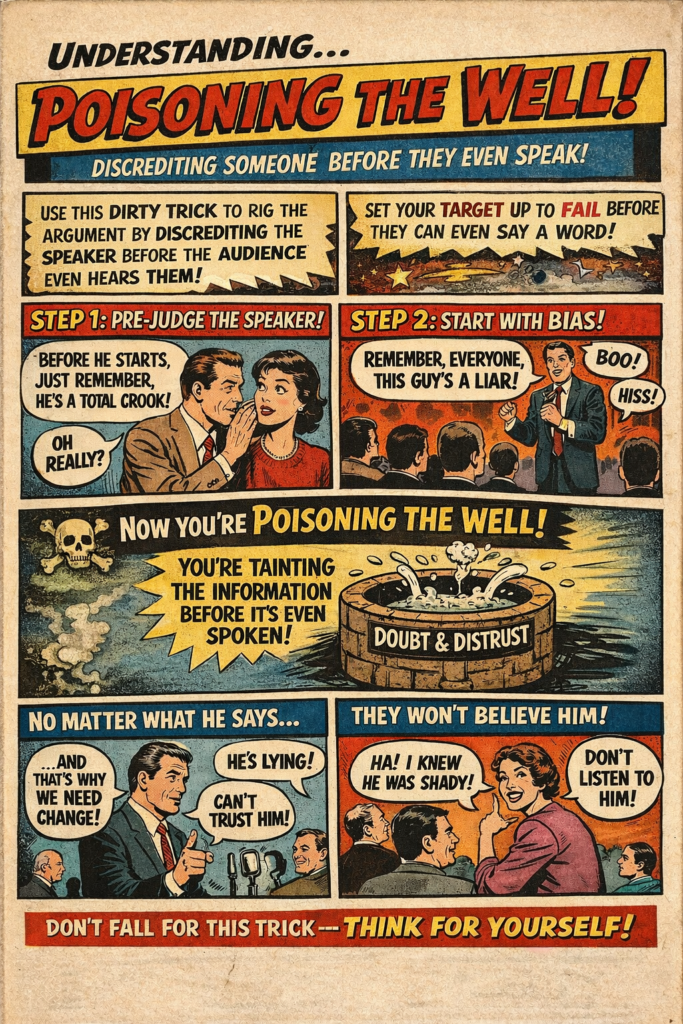
So, if you have someone evil say something reasonable, and then make everyone act like those ideas are as evil as the person saying them, then people will associate those ideas with evil. It doesn’t matter how reasonable or logical those ideas might be.
The famous “Feed the Birds” moment in Mary Poppins is the biggest, most manipulative emotional knife twist. And it’s all set up as a trap by Mary Poppins.
The children’s father tells Mary Poppins he wants to take the children with him to the bank tomorrow, with the goal of opening savings accounts for them. Mary Poppins agrees, knowing the route he’ll take to the bank.
That night, Mary Poppins sings a magical song about a homeless woman who feeds the birds, and tells the kids they should give her money if they want the saints to look kindly on them. Mary is well aware that they’ll pass this woman on their way to the bank, though the kids believe it’s simply a fantastical story.
The next day, on the way to the bank, Mr. Banks and the children encounter the homeless bird feeder. After a night of pre-programming by Mary Poppins, the children ask to give her the money Mr. Banks wants them to put in the bank.
Mr. Banks kindly suggests that the money could be saved instead. The kids freak out, they pout, and they act like monsters for the rest of the outing, eventually behaving so badly that they get their father fired from his job.
The film frames this entire sequence as a moral failure on the part of Mr. Banks. The camera lingers. The music swells. The audience is trained to feel that prudence is cruelty and Mr. Banks deserves whatever he gets after his refusal to hand over money to a homeless woman.
The real trick here is that the movie and the Feed The Birds sequence in particular aren’t actually arguing against greed. It’s arguing against long-term thinking. It reframes responsibility as emotional coldness. It quietly tells children, and the parents watching with them, that planning ahead is somehow less virtuous than impulsive generosity.
This was also one of the core beliefs of the early 1960s counterculture movement. Long-term planning was framed by hippies as “submission to the system.” That’s not in a movie like Mary Poppins by accident. That’s intentional conditioning.
Except Mr. Banks isn’t wrong. He’s right. Saving money is good advice. Teaching a child that money has future value is one of the most important lessons a parent can give. But Mary Poppins turns that into a character flaw, because the story has a set of subversive ideas it’s delivering.
That’s the only reason Mr. Banks is in the movie. He screenwashes the audience against the basic, common-sense family values that were popular at the time. Values that people couldn’t be convinced to abandon through honest debate.
In contrast to Mr. Banks, Mrs. Banks is functionally absent. She leaves the children daily to attend political causes, marches, and meetings. The film plays this as quirky and admirable. Her absence isn’t framed as neglect; it’s framed as liberation. She’s doing important work, after all. Work that happens to require abandoning her kids to a total stranger with supernatural powers.
The movie never asks the obvious question: why is it okay for the mother to be gone doing things that contribute nothing to the family, but monstrous for the father to be busy making money to support them?
That asymmetry is intentional. The film wants you to be angry at the man who pays the bills and indifferent to the woman who doesn’t come home. Responsibility is recoded as oppression. Absence is recoded as self-actualization.
When Mary Poppins arrives, she doesn’t replace the parents; she overwrites them. She’s not just a nanny. She’s a psychological counterweight. She rewards emotional indulgence. She ridicules discipline. She makes authority figures look foolish. She trains the children to associate joy with rule-breaking and resentment with structure.
This is classic emotional reframing. Emotional reframing is a persuasion technique where a person, story, or message changes how you feel about an idea without changing the facts of the idea itself.
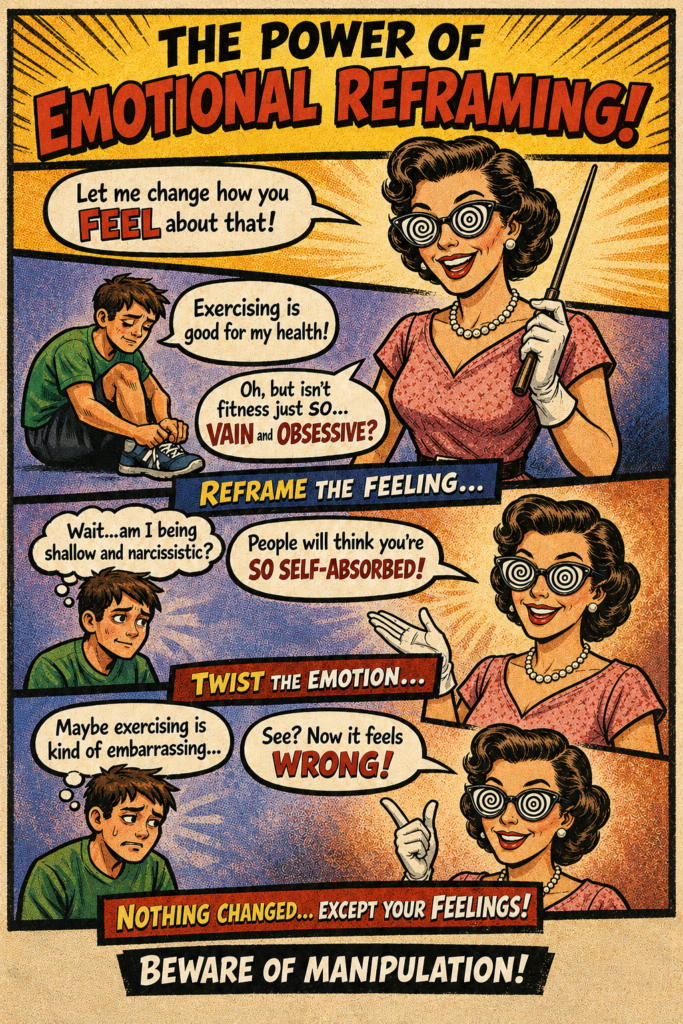
Mary Poppins doesn’t argue with Mr. Banks. She outshines him. She doesn’t prove him wrong; she makes him look irrelevant. That’s how propaganda works. You don’t refute the opposing idea; you make it feel old, uncool, and joyless.
Even the bank itself is depicted as a literal monster. Columns like teeth, employees like drones. It’s not a place where stability is created; it’s a villain’s lair. Never mind that the bank represents the very system keeping the household afloat. The audience is trained to cheer when it collapses into chaos.
By the time the movie ends, Mr. Banks has been “fixed.” How is he fixed? Not by being validated. Not by being appreciated. But by being transformed into a whimsical, kite-flying man who abandons seriousness altogether.
That’s the movie’s final trick: the father must become a child to be redeemed. He doesn’t get credit for being right. He gets rewarded for giving up. His arc isn’t growth; it’s surrender. The movie’s message is clear: responsibility must yield to sentiment, or it deserves to be mocked into extinction.
Mary Poppins teaches children that adults who plan are villains, that mothers don’t need to be present, and that money is something you feel about, not something you manage. It wraps that lesson in warmth, then dares you to question it without looking like the bad guy yourself.
That’s what being screenwashed looks like. You walk in thinking you’re watching a harmless musical. You walk out believing the most responsible person in the room was the problem all along.

In my early twenties, I was one of only three American engineers in a department of more than twenty. The rest were recent H1-B hires from India. Some were excellent engineers. Most, from what I observed, contributed almost nothing.
Our boss was a brilliant, highly motivated British engineer in his mid-thirties named Peter. Peter was expected to get the most from his department while at the same time having no authority to choose who was hired or make decisions about who should be fired.
Given limited options, and under enormous pressure, Peter did most of the work himself. He was there at all hours. Late nights. Weekends. When he wasn’t there he was logged in remotely from home, a force of nature, totally unsupported and somehow doing the complex design work of 20 men.
Things came to a head during a weekly team meeting. We’d been going for over an hour, delving deeply into the intricate complexities of making high-end microchips. Peter took a break from talking, turned to his team, and asked us for questions about what he’d been explaining.
First to raise his hand was an H1-B hire named TK. We called him TK, because his name was so long and incomprehensible, that even the other Indian employees had difficulty pronouncing it.
Peter called on him in his soft spoken and mannerly English way. He even made a joke, in an effort to make TK feel comfortable.
It’s strange, I’d forgotten how funny Peter was, until writing that, just now.
TK heaved his considerable bulk from the chair, stood with solemnity and cleared his throat, paused and then in squeaky, thickly accented English said: “Is today Tuesday?”
Peter’s face contorted visibly. He stared at an empty spot on the floor, hands pressed against the side of his navy-blue slacks. For a moment I thought he might sob. Instead, he sighed deeply and said, “No TK, it’s Friday.”
TK nodded and sat down. Peter sighed again, then walked out of the room. Unsure whether the meeting had ended, we waited a few minutes before filtering back to our cubicles. Having learned it was Friday, TK skipped his cubicle and went home early.
When I came in Monday morning, Peter’s office was dark and no one knew where he was.
A few hours later, a high-level manager we’d never seen before called us into a conference room and informed us that Peter was dead. He’d killed himself at home over the weekend, sitting in front of his computer, remotely logged in. His last act had been to launch a new routing process, and complete the design of a microchip.
Later that week I attended Peter’s funeral. His wife and seven-year-old daughter were there, having flown in from London. Few others attended and little was said by those who did.
His wife sobbed endlessly, and no one knew what to say to her. I told her Peter was one of the most brilliant people I’d ever known and that he’d been my mentor. He was brilliant, but that last part wasn’t true. Her husband had always been so busy we rarely spoke.
I didn’t have the courage to tell Peter’s wife about TK and the company decisions that had killed her daughter’s father. I doubt it would have helped.
I went in to work the next day and plopped down in my cubicle. Populating my inbox were messages from new managers I’d never heard of, demanding that we pick up the slack in the absence of the guy who’d been basically doing everything by himself.
There was no mention of firing TK or anyone else. No mention of how hard Peter had worked or how much he’d carried. No plan to replace him with engineers who could actually do the job.
I don’t remember deciding to stand up, but I do remember walking down the hallway. I remember TK’s cubicle being empty and thinking that he never comes in before noon. I remember the feeling of euphoria as I shouldered my way past workers encased in rumpled white clean room suits, silently lined up to enter and start their daily shift in the fab.
I remember singing in the car on my way home.
My phone started ringing a few hours later. I never answered and I never went back. They probably still owe me a paycheck.
It took me years to realize that what I witnessed wasn’t unique. The same war against standards had begun playing out everywhere in society.
Peter wasn’t defeated by engineering. He’d been defeated by the refusal to maintain standards. Every worthwhile institution depends on deciding who is qualified to participate and excluding those who aren’t.
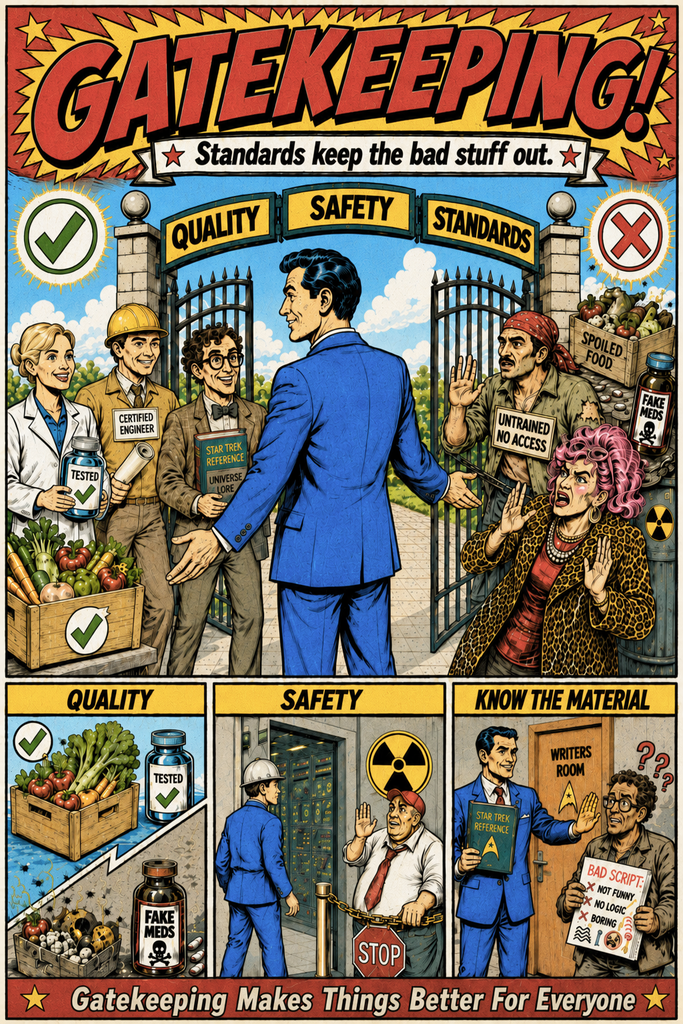
Another word for exclusion is Gatekeeping. Gatekeeping is the act of controlling access to an idea, community, opportunity, or resource by deciding who is allowed in and who is excluded.
Inclusivity stands in direct opposition to gatekeeping. In the modern usage of the term, inclusivity has become the practice or principle of ensuring that all people of different identities, backgrounds, abilities, and perspectives are welcomed, represented, and able to participate equally without regard to standards or consequences.
As part of the push towards radical inclusivity by big corporations and activists, the term gatekeeping has become a pejorative. It’s used as an emotionally charged attack against meanies. Being called a gatekeeper is the kind of thing that gets people canceled.
Yet, nothing of any worth happens without some form of gatekeeping. Gatekeeping is just another way of saying quality control. Quality control isn’t mean, it’s sensible.
Gatekeeping can be corrupt. Standards can be stupid, self-serving, or unfair. But the existence of bad gates does not mean functioning without gates is possible. It means the gates must be justified. Inclusivity is a way of removing standards, a way of deferring responsibility for maintaining quality. It’s lazy and destructive.
There was a time when high-end vacation destinations marketed themselves as exclusive resorts. Visit those same places now, and you’ll find them calling themselves all-inclusive. Private clubs have become inclusive communities. Luxury goods are now accessible luxury. Exclusive VIP access has turned into Fan access.
Exclusivity used to be the goal for everyone. It was a sign of high standards and in turn, high quality. It was something people bragged about, and businesses used to sell their services based on.
Now, inclusivity is the default representation of modern American life. It is an assumed requirement everywhere, and the term appears in almost everything. You’ll find inclusivity in corporate statements, government policies, advertising, entertainment, and nearly every discussion of any kind.
Despite the term’s ubiquitousness in your current life, it wasn’t until the year 2000 that inclusivity began creeping into common usage. Its prevalence continued to grow, and by the year 2010 inclusiveness was everywhere.
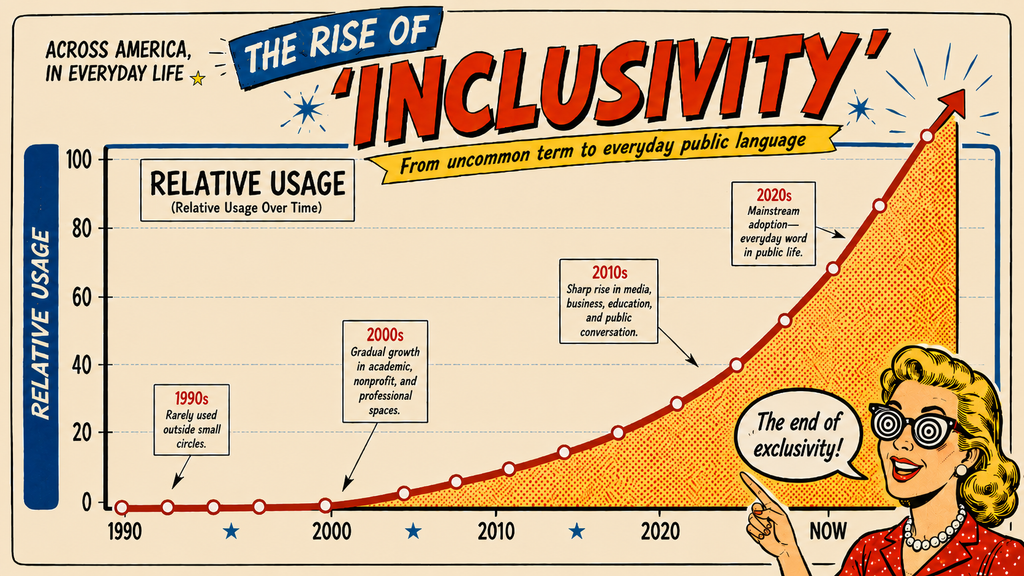
The scarcity of inclusivity’s use before the year 2000 was not because there was an alternative way of talking about the concept. It was because nobody cared about inclusivity and what’s more no one wanted it.
That changed in the year 2000, when a movie called X-Men rocked the entertainment industry and launched the previously ignored genre of superhero movies into an empire of multibillion-dollar moneymakers which spent the next 25 years dominating everything on your screens.
As superhero movies grew in popularity, so did inclusivity. In fact, it happened in almost perfect synchronicity.
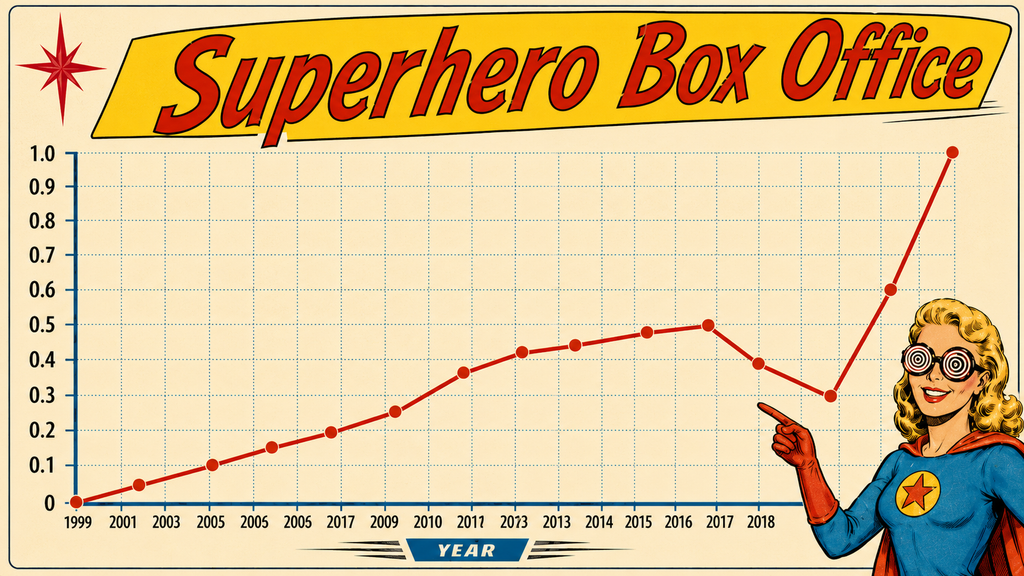
It’s hard to imagine now, but before the year 2000, superhero movies barely existed and they definitely weren’t taken seriously. There was Superman and Superman II in the 1970s, but the other sequels were a disaster.
In the late eighties and early nineties Tim Burton made two really successful Batman movies that everyone liked. Attempts to duplicate Burton’s success with films like The Shadow flopped, and even subsequent Batman movies were regarded as failures.
That was it. Superheroes were a joke, and no one wanted to invest time or money in them.
For decades, Marvel Comics had been trying to get someone to turn their popular X-Men series into a big-budget movie, with no real success. In 1994, 20th Century Fox acquired the rights to the superhero team, but still didn’t quite know what to do with them. Looking for a way to make a profit off their investment, in the late nineties, Fox approached Bryan Singer, who had just directed the groundbreaking film, The Usual Suspects.
A few years later, Bryan Singer would be the subject of multiple, well-founded allegations claiming he was involved in various kinds of despicable misconduct with large numbers of male minors. What’s more, much of that criminal activity happened in parallel with Singer’s work on X-Men. Bryan Singer’s horrific private life wasn’t public knowledge when Fox hired him. So, the studio gave him control, hoping he’d be able to crack the uncrackable superhero code.
Singer did crack the code and, in the process, created a formula that basically every successful superhero movie you’ve seen since has used. But he also put in something extra, something designed to screenwash audiences toward sharing his own, warped worldview.
The X-Men were created by Marvel Comics icons Stan Lee and Jack Kirby. X-Men #1 was published in 1963. The X-Men comics were always a little different than standard superhero stories. They weren’t as much about straight-up battles between good and evil as they were an exploration of the consequences of people called mutants, being born with strange abilities and trying to navigate the world.
Many of the best arcs in those comics involved a push and pull between two rival mutant groups. One group, led by Professor X, tried to convince humans that they could trust mutants by demonstrating good behavior. The other, led by Magneto, believed there was no way in which humans could ever accept mutants, and so sought domination and replacement. What the X-Men never really did back then was suggest that humanity should blindly welcome all dangerous outsiders, regardless of the consequences.
Enter Bryan Singer. Singer’s version of the X-Men frames suspicion of mutants so heavily as bigotry that it leaves little room for reasonable caution about genuinely dangerous individuals.
Professor X and Magneto spent decades in the X-Men comics arguing over how much latitude mutants should be given, using all sorts of logical and interesting philosophical principles. The 2000 X-Men movie covers that debate this way: Mutants should be accepted because not accepting them is wrong.
The X-Men franchise is filled with repetition centered around the idea of inclusion. It especially ramps up in Bryan Singer’s sequel X2, but his 2000 X-Men movie sets the tone for all of it with an early scene in which X-Men team member Jean Grey (Famke Janssen) testifies before Congress.
Jean faces down Senator Kelly, a man who will later be discredited by the film using a familiar persuasion tactic we’ve already talked about, called poisoning the well. Senator Kelly addresses Jean Grey and raises a concrete, real problem: mutants may possess powers that let them enter secure buildings, impersonate people, invade minds, or function as weapons. He asks if they are dangerous, and asks if they should be restricted or excluded from sensitive positions.
Jean Grey’s response is that people are mean to mutants. She ignores the question entirely, while still acting as if she’s giving a reasoned argument. Her position is that Mutants deserve unrestricted inclusion because they deserve unrestricted inclusion. Anyone who says otherwise is bad.
That’s not an argument. That’s screenwashing. A specific type of screenwashing, called a Fake Because.
“Fake Because” is a term coined by persuasion expert Scott Adams to describe the results of an experiment conducted by Harvard psychologist Ellen Langer. In 1977, Langer and her colleagues tested adults in line to use a photocopier. Langer’s team approached different people 120 times as they were about to make copies, asking to cut in front of them and go first.
Without any explanation or reason given, just a demand to cut the line, 60 percent agreed to allow the person asking to go first. When the researcher gave a reason and said, “because I’m in a rush,” compliance rose to 94 percent.
At first, Langer assumed this increase in compliance was due to the valid reason they gave. To be certain, Langer’s team tested again. This time, they gave a totally meaningless excuse by saying: “because I have to make copies.” This meaningless non-excuse produced a 93 percent compliance rate. Nearly identical to the rate of compliance to the reasonable excuse.
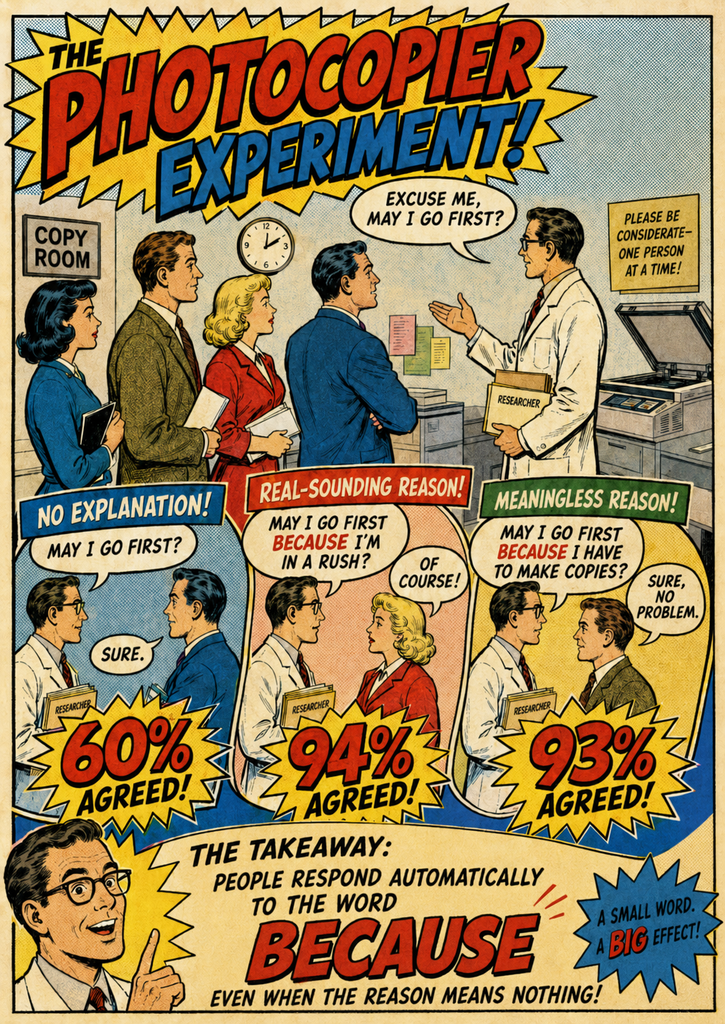
The experiment, published in 1978, proved that people respond automatically to the structure of a reason without examining whether any reason was given. Thanks to Langer’s research, we now know the Fake Because as a persuasion tactic in which a weak, circular, or meaningless explanation is presented after the word “because” or an equivalent to that word, causing the request or claim to feel justified even though no substantial reason has actually been given.
If you’re skeptical about how well this works, try it out in your own life. I have, and my success rate is above 90%.
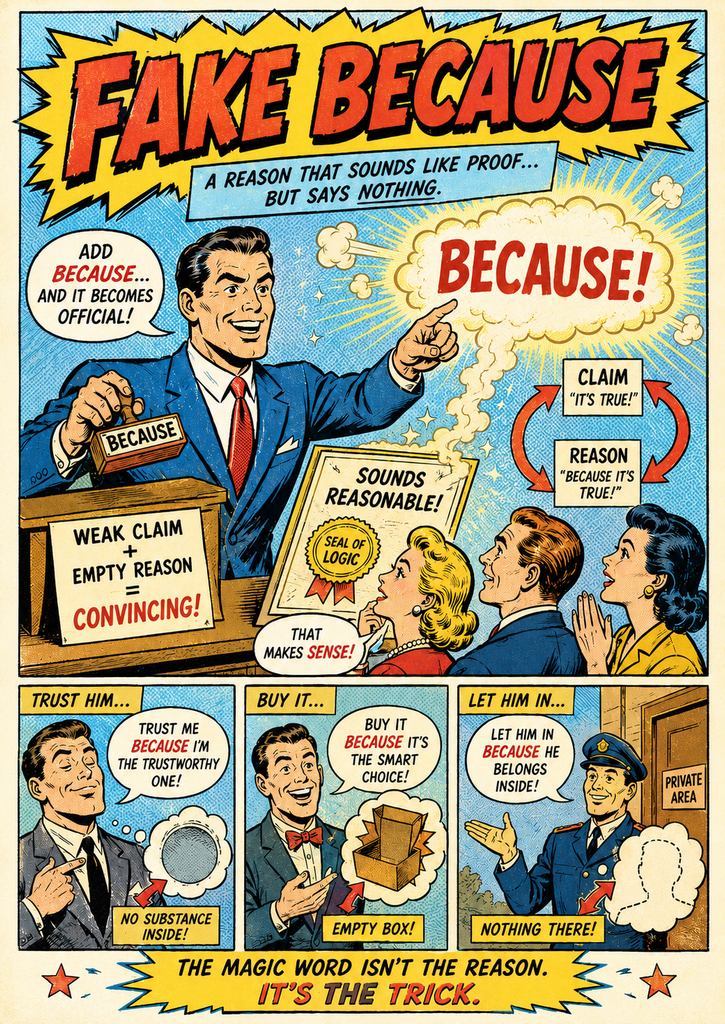
When Jean makes her non-argument, the audience nods its head, since we know Jean is the hero and therefore assume she’ll be written to give the best possible counter-argument. Whatever she says must be that. It’s a fake because, and it’s the entire point of Singer’s X-Men movies.
It’s bigger than mutants. X-Men persuades viewers to treat broad inclusion as a fundamental good by making exclusion itself the central moral evil. The audience is aligned almost entirely with the excluded, while fear of them is framed as ignorance, prejudice, or political opportunism.
Acceptance is treated as the enlightened position before the practical risks are fully examined. Even when mutants are genuinely dangerous, the movie’s emotional logic remains the same: the proper response is not caution or limits, but recognition, tolerance, and inclusion.
When Jean Grey argues for the broad inclusion of mutants, she’s arguing for all types of inclusion, because. The movie never limits its moral rule to mutants. Mutants are built as an empty symbolic category onto which viewers can project any excluded group. Since the film defines the conflict abstractly, as inclusion against intolerance, the lesson travels. Once absorbed, the same emotional framework can be applied to race, sexuality, immigration, institutions, fandoms, hiring, education, and any other dispute over who belongs.
X-Men was far from the first movie to persuade its audience towards radical inclusion. Movies like The Grapes of Wrath and even Charlie Chaplin’s The Immigrant had something to say on the subject. Movies like those had long argued for equality, tolerance, integration, and civil rights. However, those arguments were usually attached to specific people, specific injustices, and specific reasons.
This new inclusivity was different. X-Men turns inclusion itself into a moral objective, detached from any particular argument about who should be included, where, or why.
More importantly, this isn’t just about one movie. X-Men is the template for every superhero movie that followed. It is literally dozens and dozens of movies, and those movies are the most watched movies of all time.
There’s a scene in the 2025 Superman movie in which Superman confronts Lex Luthor and argues for his own inclusion as part of the human race. After the movie was done in theaters, the production released behind-the-scenes footage from the making of that moment.
In the middle of filming, David Corenswet, the thoughtful young actor playing Superman, stops everything and confronts the movie’s director, James Gunn, over the scene. Corenswet argues with his director that what the script has him saying makes no sense. He believes Superman belongs because his conduct proves his character.
James Gunn becomes visibly upset over his actor’s views. He shouts at Corenswet and insists that Superman belongs because his feelings of belonging are self-validating. Corenswet’s position appeals to demonstrated value. Gunn’s treats inclusion as a right created by the desire to be included.
When filming resumes, Gunn forces Corenswet to say that Superman should be included because Superman feels like he should be included. That’s the scene that ends up on screen.
It’s the X-Men template. Twenty-five years of superhero movies, twenty-five years of superheroes arguing that everyone should be included in everything because everyone should be included.
Inclusion without reason or exception is the worst thing that could happen to humanity. It’s the kind of idea that’s the end of everything, and it’s the end because exclusion is the only thing that keeps society functioning.
Without gatekeeping, we’d end up with unqualified pilots crashing planes maintained by unqualified mechanics. Without gatekeeping inspectors, the quality of the food you eat degrades, the drugs you need aren’t potent, and nuclear reactors go into meltdown.
Creative endeavors are no different. Without gatekeeping, a new Star Trek show hires writers who know nothing about Star Trek, and then its scripts end up filled with obvious mistakes and terrible plot holes which any fan could have spotted if they’d done some gatekeeping to hire one.
If you have standards and want to keep them, you must exclude people or things that do not meet them. Enforcing standards is difficult, time-consuming, and expensive.
I require my son to get As in math. To make that happen, I check his grades and help him with his homework when he struggles. If he doesn’t study and fails a test, I have to enforce consequences, and sometimes that’s a pain in the ass. If I remove my requirement for an A, I no longer have to do anything. My son also won’t learn math, but I’ll save a lot of time and energy.
Samurai swords are only Samurai swords as long as Claymores are excluded from being classified as Katanas. Pepsi is only Pepsi as long as you exclude lemonade from Pepsi cans. It’d be easier to fill Pepsi cans with whatever liquid is cheapest and most available, but then it wouldn’t be Pepsi anymore, and eventually people would stop buying it.
Maintaining unique differences is hard, so homogenization disguised as inclusivity allows corporations to take an established universe like Star Trek or Star Wars and wear it like a skin suit, puppeted by inclusive hires (hiring done without relevant standards) who have no idea what they’re a part of. Since they don’t care, these inclusive replacements are totally willing to treat fans like fat, juicy, pay pigs to be farmed for maximum profit. They fill Star Wars up with whatever happens to be lying around, and then play the Star Wars theme music in front of it. Because inclusivity.
Institutions survive by exercising judgment about access. Who gets authority? Who gets proximity to children? Which warning signs disqualify someone, regardless of talent, status, or profitability? Those are acts of exclusion. Refusing to perform them does not create kindness. It creates opportunity for predators.
That’s exactly the world creep Bryan Singer wanted. A world without standards, a world without expectations. A world like that is exactly the kind of world that allows evil like his to flourish. Exclusion, on the other hand, maintains the integrity of your work, your ideas, and your life. And it keeps creeps like Singer from being allowed around your kids.
Bryan Singer may be canceled now, but he got exactly what he wanted. And it all happened, because it happened.

I was 12 when I watched my mother stab my 9-year-old sister with a fork at the dinner table. Supper was always a battle of wills between the two of them. My mom would rage and scream, and my sister would sit at the table refusing to eat, in a protest that sometimes lasted hours.
That night, my sister’s resistance reached a new level. She picked up her bowl of peas and dumped them on the floor. They rolled across our tiny kitchen’s cheap linoleum, and my father sighed a deeply tired sound. My sister smiled and placed her hands flat on the pitted tabletop in front of her.
Mom said nothing. A minute passed. Then another. Eventually, the rest of us stopped waiting for her reaction and resumed eating. It was liver and onions, a dish chosen for its low cost and not its taste. I drowned it in off-brand ketchup to hide the meat’s grimy texture.
I’d just swallowed a ketchup-covered lump when Mom shrieked. She pulled back her arm and slammed the tines of her fork deep into my sister’s pale, fragile hand.
I don’t remember the blood, only cleaning it up later. But I do remember the look of betrayal in my sister’s eyes as she clutched at her hand and started to wail. I remember my Dad, still in his greasy mechanic’s coverall, sitting at the table and doing nothing while I stood up and shouted, “Mom, what are you doing!” I remember my mother snarling as she stomped off to her room and slammed the door behind her.
Things got worse after that. A year later, my Dad would be gone, kicked out after she cheated on him, and I’d be stuck home with a monster I once thought of as my mother.
I’d sit up with my mother late into the night, fighting fatigue as I tried to keep her from waking my younger siblings with her hysterics. She responded by howling and threatened to commit suicide, while I desperately tried to comfort her and preach calm, afraid she might really do it this time.
In the morning, she’d emerge from her room long enough to scream me out of bed, and I’d trudge out the door to school as she serenaded me with a detailed accounting of how much she wished I’d never been born.
I still remember the first time she told me she hated me. I don’t remember any of the others.
In the evenings, I returned to find her locked back in the upstairs bedroom, leaving me to cook rudimentary meals for my little brother and sister. I’d beg her to come out long enough to buy supplies we needed at the store, but my only answer was the sound of whatever soap opera she had playing on the television.
Once part of the school’s talented and gifted program, my grades plummeted and I couldn’t keep up. My teachers didn’t seem to care or notice. They kicked me out of the advanced classes I’d been in since elementary school and sent me to remedial math, where everyone acted as if that’s where I’d always belonged.
I called family I thought I was close to and begged for help. “Mom’s going to kill herself,” I said. They told me they had their own problems. I told ministers at the church I grew up in, people I’d always believed I could trust. “We’re running out of stuff because Mom won’t come out of her room,” I told them. They nodded their heads and suggested some Bible passages. No one reported her to CPS or brought us any food.
My mother’s evil might sound like something that should be condemned, but in 2026 HBO produced a streaming series aimed at convincing people that she, and the people who refused to help me, were right.
The streaming series is called Lanterns, and like the Superman movie that preceded it in 2025, James Gunn produced it. It’s about a superhero named Green Lantern, who, if you’re not familiar, is a man with a ring of power that lets him create anything he can imagine.
Lanterns is the story of an aging Green Lantern named Hal Jordan, played perfectly by Kyle Chandler. He’s in the process of training an apprentice named John Stewart. It uses the two of them to construct a superhero origin story around the idea that parents can, and sometimes should, terrorize their children for their own good.
For you see, John Stewart was raised from birth to become Green Lantern by his parents. While still a baby, his mother learns John’s father would have been chosen as the Green Lantern instead of Hal, if only John’s father hadn’t been afraid.
John’s mother decides to “condition” (she actually uses the word “condition”) her son to be fearless. Her way of doing that is by enlisting his father in subjecting their baby boy to extreme levels of child abuse.
It works. John Stewart grows up and gets selected by the Guardians to become the next Green Lantern.
This is Reward Framing.
Reward Framing is a persuasive narrative technique in which an action is followed by a desirable outcome, encouraging the audience to view the action as effective, justified, or worthwhile, even when the action is harmful or morally condemned.
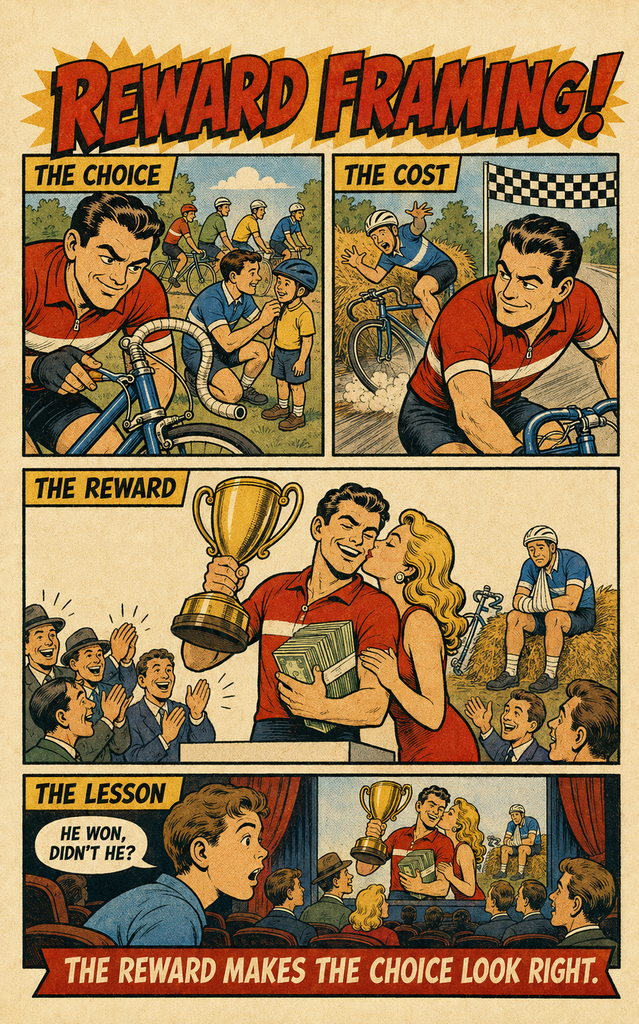
Before we go deeper into what they do to him, I need to make sure everyone reading understands what child abuse is. Often when child abuse is mentioned, people think that means physical assaults, like the one suffered by my sister, or worse. However, as demonstrated by my own story, child abuse does not begin and end with physically harming a child. There are other forms of child abuse, some even more harmful than physical aggression. Those include things like deliberately terrorizing them, emotionally attacking them, neglecting their safety, depriving them of normal development, and subjecting them to extreme danger. John’s parents do all of this systematically, not because they lose control, but because they believe abusing their child will make him stronger.
The worst and most carefully depicted of their many abuses involves John’s parents shooting at him. At an early age, both his mother and his father begin shooting apples off his head, while forcing their son to tell them he isn’t afraid. The show frames these attacks as bonding moments. When the shooting’s over, and John’s not dead, he gives his parents a hug. Then they take him out for a burger.
Shooting at their son is only part of the sick conditioning plan. John’s parents abandon him alone in dangerous neighborhoods and force him to find his way home alone. They deny him ordinary childhood pleasures because comfort might make him weak. Eventually, they force John himself to point a gun at his father and shoot an apple off his head.
This is not one terrible lapse in judgment. It is a system of abuse, maintained throughout his childhood and directed toward a single objective: eliminating fear.
Lanterns is not a television show merely depicting abusive parents. The show’s third episode devotes its entire runtime to constructing and validating a specific chain of cause and effect around this concept. John’s parents decide that fear will prevent him from becoming Green Lantern. They deliberately abuse him to eliminate that fear. John grows into the fearless man they intended to create. That fearlessness qualifies him for the power they wanted him to receive.
John’s selection vindicates the theory that child abuse will make someone fearless. Adult John then supplies moral validation: he still loves them, seeks their advice, and says that he owes them. Their methods are dangerous, but they achieve their stated objective. Their victim suffers, but the series has not shown him regarding that suffering as an injustice. Their actions are abusive, but the result is a superhero.
That is the difference between depicting abuse and rewarding it. Lanterns does not merely show us what John’s parents did. It constructs his heroism as the payoff for what they did.
This is Narrative Normalization.
Narrative normalization is a persuasive storytelling technique in which repeated, sympathetic, or consequence-free portrayals of a harmful behavior make it seem ordinary, understandable, or acceptable to the audience.
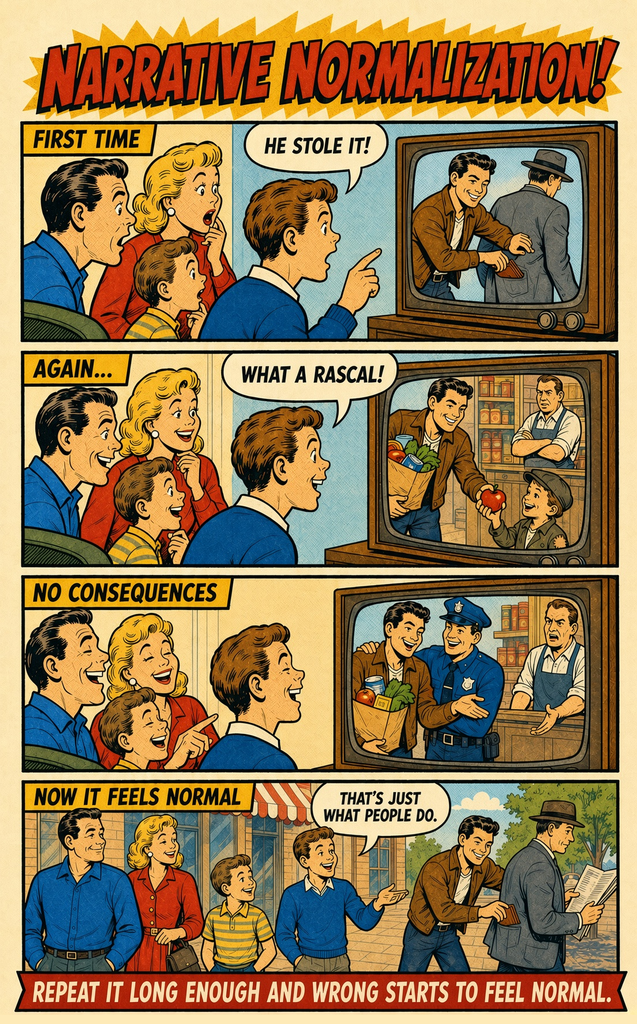
These kinds of portrayals obviously won’t cause people to start abusing their kids to give them superpowers, because everyone knows there’s no such thing as superpowers. What it does do is normalize abusing children as a method of making them stronger.
In one of the stranger cultural coincidences in recent memory, Lanterns arrived on television at exactly the same moment America was grappling with the case of Lindsay Clancy, a mother who killed her children and claimed that a voice told her killing them was the only way to keep them safe.
The connection between this real-life event and the fictional events of Lanterns is the moral lie at the center of both stories: that hurting a child becomes an act of love when the person doing the hurting claims it is for the child’s own good.
That is exactly how Lanterns rationalizes John Stewart’s abuse. His parents terrorize him, endanger him, and deny him a childhood, but because they say it’s necessary for his future, the show treats their cruelty as sacrifice. Then it rewards them by turning their victim into precisely the superhero they intended to create.
The message is that abuse can be love if it gets results. They set out to abuse fear out of their son; he became fearless; and that fearlessness made him Green Lantern.
My mother abused me for years, and it resulted in this book. By Lanterns’ logic, that somehow makes what she did acceptable.
For my part, I’d rather have a good childhood than this book.

I was editing this book while watching my nine-year-old son Avery through a window at a youth chess tournament.
Our chess club’s kids organized a game of tag outside on the lawn between rounds, and as I covertly observed, it devolved from running and chasing into throwing crab apples. I went outside and warned Avery to stop throwing fruit at his friends. In the process, I accidentally revealed to him that I could see everything they were doing from my window.
Over the next ten minutes, I watched as my son carefully led the entire group, one small decision at a time, beyond my line of sight, without any of them appearing to realize they were being led. Back outside, I found them hiding behind cars in the parking lot, playing a game of who can throw water bottles the hardest.
Avery finished second in the chess tournament.
God help the parents of the kid who finished first.
Avery never ordered anyone to leave or announced a plan. If he had, his friends wouldn’t have listened, since everyone was having fun on the grass. Instead, he arranged a series of small choices until his playmates arrived exactly where he wanted them to be.
That’s how the most effective, most dishonest forms of screenwashing work. It never orders you to go anywhere. Instead of making an argument and letting you decide if it makes sense, this kind of persuasion makes each step feel like your own idea, until you arrive exactly where it wanted you to be.
Propaganda is the term for dishonest persuasion done through manipulation. The antidote to dishonest propaganda isn’t silence. It’s reasoncraft.
Reasoncraft is persuasion through openly stated reasons and honest exploration, rather than manipulation.
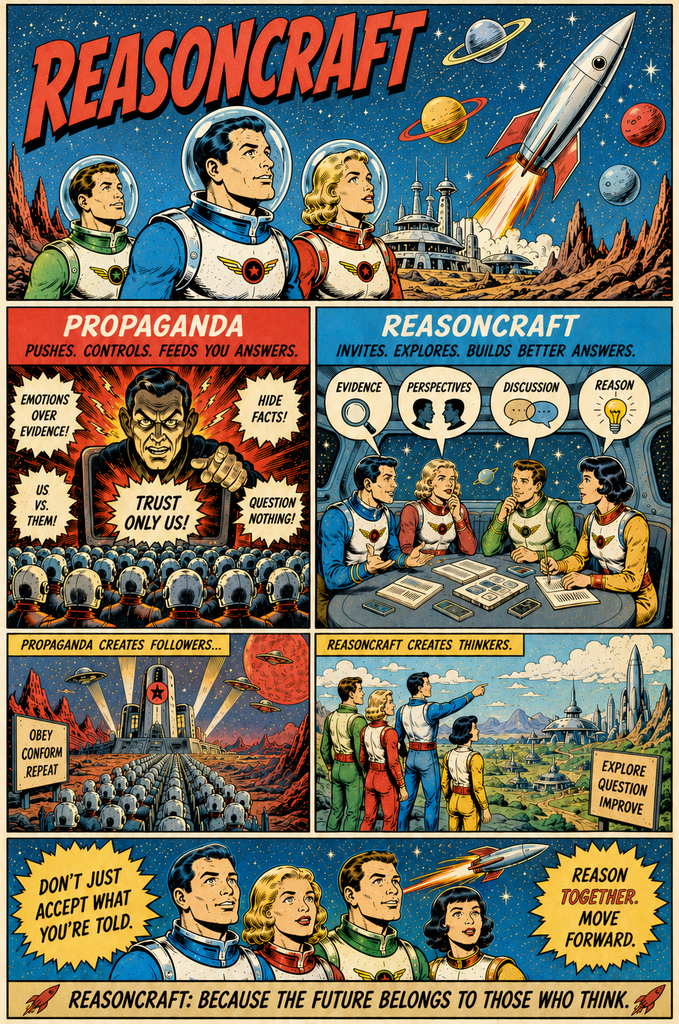
There’s no better example of reasoncraft than Star Trek. All of Star Trek. Even modern Star Trek.
The modern Trek series Star Trek: Strange New Worlds kicked off its fourth season with an episode titled “Valles Marineris.” The Enterprise travels 65 million years into the past and discovers that Mars was once home to an advanced civilization. It was nearly destroyed by intelligent insectoids who migrate to other planets and consume their resources.
The Martians stopped them only by tearing open their own planet, killing the invaders along with two million Martians. When Captain Pike suggests there might have been another solution, a Martian commander tells him that her people once thought the same thing: “As they talked, we died.”
Enterprise’s crew then discovers an insectoid colony ship that crashed on prehistoric Earth. Lieutenant Ortegas sympathizes with its dead occupants: “They may be different from us, but they wanted to survive too.” Her more practical partner responds, “If they were settlers, I’m not sure if I should feel sad or relieved.”
In these exchanges, Strange New Worlds goes out of its way to air varying points of view on the situation. The episode didn’t hide the views of those who might oppose what it does next.
With the time for discussion ended, Captain Pike quickly realizes the inescapable truth. If this insectoid race sends “settlers” to Earth, they’ll destroy our future. Choosing survival over sentiment, Pike allows the Martians to blow up the insectoid planet and genocide its race of resource-consuming migrants.
The episode, which is clearly about modern issues of mass migration, doesn’t conceal the opposing position or make its advocates look stupid. It states their argument clearly, then follows the problem to its logical conclusion.
That’s what Star Trek has always done, and what the best science fiction usually does. It restates a real-world problem in a fictional setting so the audience can reason through it without all the political noise. This is persuasive, but it isn’t propaganda. It’s reasoncraft.
Even at its lowest point, Star Trek remains bound to reasoncraft. That’s why the series Star Trek: Starfleet Academy is so badly written.
Reasoncraft forces an idea to survive contact with its consequences. When Starfleet Academy rationally explores its ideological premises, those premises repeatedly produce stupid decisions, irrational behavior, and disastrous results. The story itself proves that its ideas don’t work.
But the show’s writers are too committed to those ideas to accept what their own story has demonstrated. So the characters continue treating failure as wisdom, the script declares obviously bad decisions correct, and consequences are ignored or rewritten to protect the intended message. The reasoning leads one way while the show insists it led somewhere else.
That contradiction isn’t caused by reasoncraft. It’s what happens when writers use reasoncraft but refuse to accept its answer. The result is a story that no longer makes sense.
Reasoncraft is also why better Star Trek shows, like Star Trek: Deep Space Nine, are so good. When that series tackled a complex issue and used reasoncraft, they followed it through to its logical conclusion, even if that conclusion didn’t always fit with their personal ideology. That willingness to follow the story where reason takes it, even if that conflicts with the beliefs of the show’s writers, is what makes reasoncraft honest.
Star Trek’s example demonstrates why bad actors with bad ideas resort to propaganda. Dishonesty is the only way to screenwash others into believing something that doesn’t fit with logic and evidence, without also creating an entertainment product that plays out like something written on the side of a bathtub with a water crayon.
Audiences have expectations. Bill your film as a comedy, and they expect to laugh. Position it as a horror movie, and they’ll rightfully be looking forward to a few scares. That doesn’t mean anyone expects to know the details of your story before they’ve watched. It does mean people reasonably expect the nature and purpose of the product to correspond with how its creators present and market it.
It’s like filling Pepsi cans with lemonade and then excusing it by telling consumers to stop complaining because it’s really good lemonade. It’s the dishonesty that’s the problem, not the quality of the liquid in the can.
When you lie to your audience about what you’re doing, you aren’t just manipulating them. You make them into the worst kind of slave: people who think they’re choosing freely, while you’re quietly stealing their free will.
All men must be free to think any thought. Avery is. I’m not so sure about his friends.
For More Samples or Inquiries: josh@walkbig.com